The Microsoft Effect on Upper Westside Home Values Was Real. It Just Wasn't What Buyers Think.
August 20, 2026
August 20, 2026
For most of 2021 through 2023, it was hard to find a listing in Bolton, Riverside, or Whittier Mill Village that didn't mention Microsoft somewhere in the description. The tech giant had bought 90 acres at Quarry Yards in the neighboring Grove Park area, and agents wrote it into their copy the way you'd mention a good school district: as a reason the price would keep climbing. The story was simple and it was everywhere. A 15,000-job corporate campus was coming to the Westside, and anyone who bought nearby was buying ahead of it.
Here's the part that didn't make it into as many listings: that campus was quietly paused in February 2023, and it has stayed paused since. If you're comparing Upper Westside to other intown-adjacent neighborhoods right now, the useful question isn't whether Microsoft is coming. It's what actually got built while everyone was waiting, and whether that's a better reason to buy than the one that didn't pan out.
Microsoft's Quarry Yards purchase was not a rumor. The company paid $127 million for the original 70-acre site in 2021, then added another 20 acres nearby for $22.5 million, bringing its total holding to 90 acres just south of what is now Shirley Clarke Franklin Park, formerly Westside Reservoir Park. The plan, as described at the time, was a campus that could eventually employ up to 15,000 workers, with a promise to dedicate a quarter of the land to affordable housing and community use.
That kind of announcement moves a housing market before a single foundation gets poured. Reporting on the Westside at the time described home-price increases and land speculation going into overdrive on the strength of the announcement alone, with listings across the area routinely citing Microsoft's presence as a selling point. Buyers weren't just purchasing a home. They were purchasing proximity to a promise.
The campus never broke ground. Microsoft put the project on indefinite hold in February 2023 while it reappraised its real estate holdings, and for nearly three years the 90 acres sat exactly as they had before the announcement: vacant, fenced, and waiting.
In November 2025, the story took its next real turn. Rather than resuming campus plans, Microsoft announced it would donate 22.5 acres of the site to the City of Atlanta through the Atlanta Urban Development Corporation, earmarked for affordable housing and community resources near Donald Lee Hollowell Parkway. Mayor Andre Dickens called it a partnership that would strengthen the Grove Park community. AUDC's chief executive, John Majors, was candid about the timeline when asked directly: a request for development partners isn't expected until the fourth quarter of 2026, a partner might be selected by the second quarter of 2027, and shovels in the ground could realistically be a 2028 event. He estimated 400 to 500 residential units are conceivable, though nothing about affordability mix or unit type has been finalized.
The land transfer itself is expected to close sometime in the middle of 2026, roughly five years after Microsoft's original announcement reset expectations for the whole area. That is the actual pace of this project: not a corporate campus, not 15,000 jobs, but a multi-year affordable housing planning process that hasn't yet selected a builder.
While Quarry Yards sat vacant, a different developer was finishing something a few blocks away. Lincoln Property Company's Echo Street West, a 19-acre project along the BeltLine's Westside Connector Trail, delivered its first phase: a four-story, roughly 300,000-square-foot mass timber office building known as 765 Echo, built with steel and cross-laminated timber and marketed as Atlanta's first exterior-core office building of its kind. The site also includes Guardian Studios, a converted factory space now leased to a roster of working artists, the Westside Motor Lounge, and the 292-unit Vibe apartment community, twenty percent of which is reserved as affordable housing.
This is the part of the Upper Westside story that's easy to miss if you're only tracking the Microsoft headline. Echo Street West didn't wait on a mayoral announcement or an RFQ process. It broke ground, topped out, and leased space while the more famous project next door stayed paused. If you're trying to gauge what's actually changing the character of this stretch of the Westside, a finished 300,000-square-foot building with tenants in it is a stronger signal than 90 acres of vacant land with a plan attached.
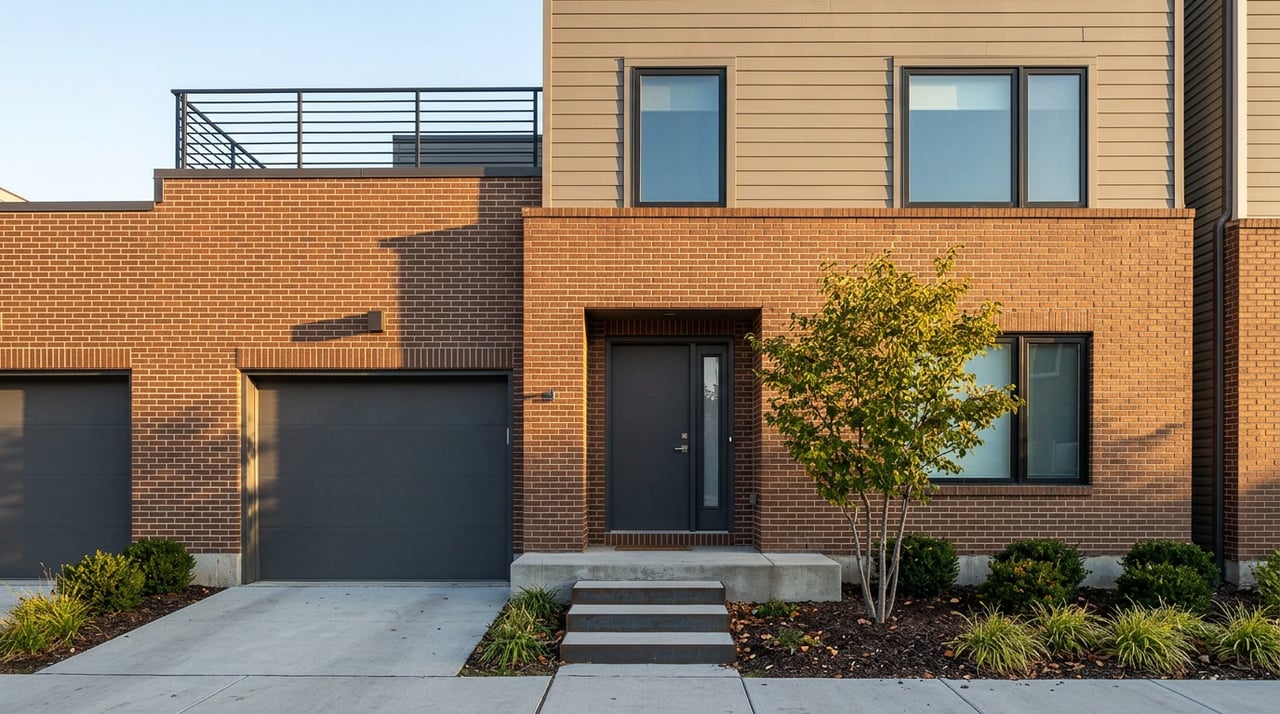
Prices on the ground reflect that split between promise and delivery. New construction is showing up at prices that would have been hard to find a few years ago closer to the BeltLine core. South City Towns, a new for-sale townhome project off Bolton Road in the Upper Westside's English Park pocket, recently began listing three-story units from the low $300s, with early offerings priced at $329,990 and $334,990 for two bedrooms and two and a half baths across 2,198 square feet. That's roughly seven miles south of The Battery Atlanta and about four miles west of Shirley Clarke Franklin Park, the city's largest greenspace, and it's being marketed explicitly as more affordable than renting in the same footprint.
That price point matters for anyone comparing Upper Westside to Brookhaven, Chamblee, or North Druid Hills on a spreadsheet. You're not paying a premium for a campus that hasn't broken ground. You're paying for a genuinely industrial-to-residential neighborhood with a completed timber office building, an active BeltLine trail connection, and new construction still priced for a first-time buyer rather than a move-up family.
The practical lesson here isn't that the Upper Westside was oversold. It's that two different kinds of information were circulating at the same time, and they deserve different weight when you're comparing neighborhoods.
A corporate announcement is a plan. It tells you what a company hopes to do, subject to budget cycles, leadership changes, and reappraisals that have nothing to do with the neighborhood itself. A completed building, a signed lease, a trail connector you can walk on today: that's delivered value, and it doesn't disappear if a parent company's five-year plan changes.
When you're weighing Upper Westside against another intown option, ask which category each selling point falls into. Echo Street West and the BeltLine's Westside Connector Trail are delivered. The 22.5-acre affordable housing parcel is a real commitment with a real timeline, but it's still years from occupancy. Anything still attached to Quarry Yards beyond that gifted parcel remains an open question, since Microsoft's plans for the rest of the site are still paused with no announced resumption date.
Will Quarry Yards ever become the tech campus that was originally announced? There's no public timeline for that. Microsoft's campus plans have been paused since February 2023, and the only concrete movement on the 90 acres has been the 22.5-acre land gift for affordable housing, which is a different project with a different purpose than the original announcement.
Does the paused campus mean Upper Westside home values are overhyped? Not necessarily. It means the neighborhood's value case has shifted from a speculative corporate anchor to delivered infrastructure like Echo Street West and new construction like South City Towns. Buyers should evaluate what's finished and occupied today rather than what was promised in 2021.
When will the affordable housing units on the donated parcel be available? Based on AUDC's own stated timeline, a development partner isn't expected to be selected until the second quarter of 2027, with construction potentially starting in 2028. There's no unit count, affordability mix, or opening date finalized yet.
If you're comparing the Upper Westside to other Atlanta neighborhoods and want a clear-eyed read on what's actually built versus what's still on paper, that's exactly the kind of local homework Ellen Cook does for every buyer conversation. Reach out to request a personalized buyer consultation or a home valuation, and we'll walk through what's finished, what's funded, and what's still just a plan.
Stay up to date on the latest real estate trends.

Ellen Thomas blends analytical insight with refined service to deliver a seamless real estate experience. Known for her thoughtful guidance and strong client advocacy, she helps buyers and sellers navigate every move with confidence and clarity.